 |
|
 |
|
 |
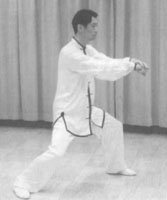
Punch
of Covering Hand (Yan
Shou Chui) |
|
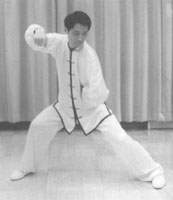
Punch
of Draping Over Body
(Pi Shen Chui) |
|
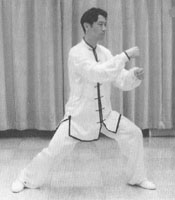
Punch
of Protecting Heart
(Hu Xin Chui) |
SOME NOTES FROM THE TRANSLATOR
[1] The number
of routines practiced within
Small Frame system is not
really clear. Ms. Chen Peiju
said that before Taijiquan
was created by Cheng Wangting,
Chen clan practiced Long Fist
Boxing in 108 Postures (Yi
Bai Ling Ba Shi Chang Quan)
that they brought from Shanxi.
Chen Wangting created five
routines of Taijiquan. Nowadays
mainly First Set and Second
Set are practiced. This is
also "official"
version that can be found
in books on Small Frame (including
recently published - one by
Chen Liqing - famous Chen
style Taijiquan expert living
in Xi'an - and one by Fan
Chunlei - Chen Liqing's grand-disciple
from Hangzhou). However other
sources - including articles
in Chinese martial arts magazines
- indicate that apart from
Yi Lu and Er Lu other Taijiquan
routines have been preserved
within Small Frame system.
I had a chance to talk to
disciples of Mr. Chen Boxiang
(Chen Kezhong's disciple)
from Pingdingshan as well
as Mr. Shi Lei (Chen Kedi's
disciple) from Kaifeng and
they all confirmed other routines
are also in Xiao Jia's curriculum.
[2] This
sentence as well as all other
in quotations in this part
of the article come from "Essentials
of Taijiquan Practice"
(Taijiquan Lianxi Gaiyao)
written by Chen Boxian (student
of Chen Kezhong). The sentence
"contract the ribs, the
skin on the ribs and hand
should touch each other"
(Shu Lei Xiang Mao Fu Xiang
Ai) means that when the hand
moves towards the body, its
forearm should be kept close
to the ribs so that there
is a feeling of contact between
the skin of the torso and
the arm. However at the same
time the hand should not be
moved too close to the body
(Jia). As Ms. Chen Peiju explains
"during the movement
the arms should not leave
the ribs; the elbows should
move close to the body; right
arm moves on the right side
of the body's central line,
left hand - on its left side".
[3] As Ms.
Chen Peiju explains "Small
Frame basically never withdraws
power back (Hui Jin) unlike
Large Frame (where movement
changes direction to the opposite
one couple of times before
one moves to the next posture);
in Small Frame the end of
one movement is at the same
time the beginning of the
next one; the end of "explosion"
(Bao Fa) of the preceding
movement is at the same time
"Storing of Strength"
(Xu Jin) of the next one;
this is one of the difficulties
in learning Small Frame".
[4] As Ms.
Chen Peiju explains that "in
Small Frame one moves the
body center along curves -
there should not be any kind
of horizontal, straight line,
swaying movement. The idea
of "Opening the Rear
and Closing the Front"
(Hou Kai Qian He) is also
very important, whole body
should "open at the rear
and close at the front".
For example: if we stand in
Horse Riding Stance (Ma Bu)
with hands in front of the
body in embracing gesture,
vertically - from the top
of the head to the bottom
of the feet the body should
form a vertical sphere; horizontally
- the crotch, waist and chest
- each of them has a vertical
sphere as well; taken all-together
the body forms a three-dimensional
sphere. Actually all joints,
all key links in power transmission
from the bottom upwards, are
small spheres. When crotch
opens, it creates a circular
supportive force, so-called
"Crotch Strength"
(Dang Jin). Waist is above
crotch - it is responsible
for changing the direction
of this strength - that's
why we say that "waist
is the absolute ruler"
(Yi Yao Wei Zhuzhai). In all
martial arts power comes from
the bottom and is transferred
upwards, and through the waist
transferred to the back, shoulder,
elbow, hand which is the point
the force acts. The value
of force changes in legs,
the direction of force - in
waist, the point the force
acts - in various parts of
the body."
(1)(2)(3)(4)(5)(6)(7) |


