Illustrated
Explanation to Chen Family Taijiquan"
(Chen Shi Taijiquan Tu Shuo) written
by Chen Xin (16th generation descendant
of Chen clan) and considered "Bible
of Martial Arts" (Wulin Shengdian),
describes movements which are practiced
within "Small Frame" system.
Chen Xin's own "Introduction"
(Zi Xu) to "Illustrated Explanation"
says:
"I am afraid of the passing
of time and impatient to wait anymore;
I'm also afraid that (the martial
art) will divide into schools and
branches and true knowledge will
be lost. For this reason in my leisure
time I do my outmost to explain
and clarify deep secrets (of the
art), describe it in great detail."
In the whole book there is no mention
about the division of Chen style
Taijiquan into Large Frame and Small
Frame.This proves that the style
recorded in "Illustrated Explanation
to Chen Family Taijiquan" should
be the closest to the original art
created by Chen Wangting.
|
|
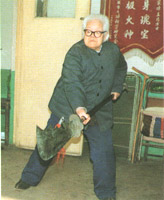 |
In
spite of her advanced age,
Chen Liqing still actively
teaches in Xi'an |
|
THE CHARACTERISTICS OF "SMALL
FRAME" OF CHEN STYLE TAIJIQUAN
Body
Method (Shen Fa): "The body
should not leap up and sway carelessly,
rather low than high, move on one
level". During practice of
the routines the body should not
move now low now high, and carelessly
sway to the left or right; the Intent
(Yi) should sink down, the center
of gravity should be kept low and
basically on one level (apart from
movements like "Shake Foot
and Stretch Down" - Bai Jiao
Xia Cha; Golden Rooster Stands on
One Leg - Jin Ji Du Li; The Dragon
on the Ground - Pu Di Long, etc.)
Hand
Techniques (Shou Fa) - "Both
hands should not (carelessly) turn
over, there should be closing power
between them, Qi penetrates slightly
insides of the fingers; when moving
hands upwards do not cross eyebrows,
move them downwards by relaxing;
(when) turning (i.e. moving the
hands) inwards (i.e. in front of
the body) thumb can go as far as
the central line, when moving (the
hands) outwards do not extend them
too far, sink the tip of the elbow;
do not extend it too far (Tan) do
not keep it too close (Jia), contract
the ribs, the skin on the ribs and
hand should touch each other (Shu
Lei Xiang Mao Fu Xiang Ai)"[2].
Both hands close (He), (i.e. are
turned towards each other), they
should not completely face each
other but rather at a certain angle
- this is called "Four Six,
Yin and Yang"; palm is shaped
like a tile, thumb and little finger
close (He, i.e. move towards each
other), the Intent (Yi) is on the
thumb, forefinger and middle finger;
the center line of the body determines
range of motion for each hand, each
hand controls half of the body;
in its movements upwards the hand
should not go higher than the level
of eyebrows, when moving downwards
one should focus on relaxation;
when the hand moves outwards, do
not extend it too far (Tan); when
the hand returns, do not keep it
too close to the body (Jia), leave
some extra space, follow exactly
the principles.
Footwork
(Bu Fa) - "Never place the
feet in the shape of character Ba
(eight - which is similar to roman
letter "V" written upside
down - i.e. with toes pointing obliquely
outwards) and Ding (similar to the
letter "T" i.e. when there
is right angle between both feet),
always remember to close (i.e. move
towards each other) tips of both
feet; more weight of the body is
on inner side of the feet, big and
second toes lead (the foot); twist
on heels, big step is as long as
one leg, short step is as long as
one vertical foot". Because
of the requirement to open hips
and round the crotch, both feet
should be kept parallel to each
other, and never placed with toes
pointing outwards (in the shape
of letters "V" or "T"),
otherwise the hip joint will not
fold and crotch will loose its curve
(and will take shape of "V"
letter - so-called "sharp crotch"
- and hence the requirement of rounding
the crotch will not be met); when
moving from hips down using "contrary
coiling" (Ni Chan), the strength
vector should drop on the inner
side of the foot, onto big and second
toes; when taking a step, one should
not extend it too far (Tan) - one
should be able to take a step and
draw the leg back freely, in big
step the distance between feet should
not be longer than length of the
leg, in small step - not shorter
than length of the foot.
|


