|
|
|
 |
|
(Chen)
Qingping passed (Taijiquan)
to He Zhaoyuan, Zhang Kai,
Zhang Gaoshan of Zhaobao town.
(Chen) Youlun passed (Taijiquan)
to Li Jingyan, Zhang Dahong".
From the
above record it can be seen
that both Chen Gongzhao and
his son, Chen Youben, were
martial artists of great attainments
and had many famous disciples;
Chen Youben evidently received
true transmission of Taijiquan
from his father. Moreover
Small Frame already existed
before Chen Youben.
|
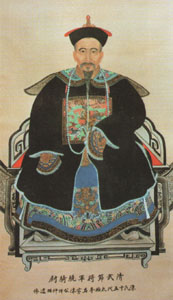 Chen
Zhongshen (1809-1891)
became famous fighting
against Taiping rebels
in 19th century
Chen
Zhongshen (1809-1891)
became famous fighting
against Taiping rebels
in 19th century
|
|
Small
Frame combines hardness
with softness, there
is more softness and
less hardness in the
First Set (Yi Lu), more
hardness and less softness
in the Second Set (Er
Lu). Furthermore since
Small Frame has a very
complete theoretical
system and strict, step-by-step
method of practice,
people in Chenjiagou
praise it as "Gongfu
Frame" (Gongfu
Jia) or "Special
Frame" (Kan Jia
Quan; Kan Jia literally
means "look after
the house"). It
is not that - as some
books say - "Chen
Youben, 14th generation
descendant of Chen clan,
made some changes to
the original routines,
gradually abandoning
some more difficult
and vigorous movements,
and created New Frame
(Xin Jia), also called
Small Frame, as extended
as Old Frame (Lao Jia)"[6].
Since Chen Changxing
was escorting caravans
away from home all the
year round, Chen Gengyun
(Chen Changxing's son
and 15th generation
descendant of Chen clan),
in order to work together
with the father, asked
Chen Youben, his uncle,
to teach him. In order
to help Chen Gengyun
achieve skill in the
shortest possible time,
Chen Youben, while preserving
the quintessence of
the First Set (in) Thirteen
Postures (Tou Tao Shi
San Shi), put emphasis
on "Power Explosions"
(Bao Fa Li), enlarged
the movements, and coached
Chen Gengyun for over
a year. Chen Youben
and Chen Gengyun through
discussions and thorough
studies created a certain
type of frame;
|
since
then, in order to differ
it from First Set (in)
Thirteen Postures (Tou
Tao Shi San Shi), people
began to call them "Small
Circles" and "Large
Circles". Chen
Gengyun passed this
frame to his family
members; it was also
taught to Chen Fake
- his grandson - who
in 1928 was invited
to Beijing to teach
martial arts, and made
this frame known to
the public. Later generations
began to refer to this
frame as "Large
Frame" (Da Jia),
while to traditional
system as "Small
Frame" (Xiao Jia). |
|
DISPUTES
CONCERNING "ILLUSTRATED
EXPLANATION TO CHEN FAMILY
TAIJIQUAN"
Why
"Illustrated Explanation"
[7] describes 64 postures,
and not 74? This is because
Chen Xin while writing "Illustrated
Explanation" "avoided
the trivial and dwelled on
the important", chose
only essential postures and
described them, so not the
complete routine is recorded
in the book. For example Preparing
Form (Yu Bei Shi), Closing
Form (Shou Shi) and some linking
or transitional movements
were not recorded. Although
some of them were explained,
but were not listed as separate
postures ("Book Of Changes"
- Yi Jing - includes 64 hexagrams,
so it is possible that the
number of postures in Chen
Xin's book was influenced
by the number of hexagrams
in Yi Jing).
Why
is the book so obscure and
hard to understand? This is
because "Illustrated
Explanation" is not a
textbook for beginners. It
provides guidance to those
practitioners who already
reached certain level of skill
and of understanding the theory
and are looking for higher
attainment. Moreover taking
into consideration the specific
ways classical compositions
are written, lack of periods
and commas, using local dialect
and slang in some passages,
it all makes the text very
difficult to fully understand
by a beginner or a person
without at least basic understanding
of classical Chinese. Furthermore
since the meaning of some
characters in "Illustrated
Explanation" differs
from that of modern Chinese,
in the process of learning
one should combine experience
coming from practice to understand
the essence of the book.
Some
crucial parts are simply omitted.
For example in some places
the book only describes the
goal of practice, but does
not explain the method and
process how to achieve this
goal. Perhaps because of conservative
thinking at Chen Xin's time,
influence of the traditional
idea of "giving you the
medicine, but not telling
you how it is made";
maybe because of limitation
of words in conveying his
ideas, some things that can
be passed only through direct
teaching could not be explained
in the book.
"Illustrated
Explanation to Chen Family
Taijiquan" (published
in 1931) has at its end Du
Yuanhua's "Du Yuwan Account
of Rhymed Formula Received
by Jiang Fa from his Teacher
of Shanxi"; this "Rhymed
Formula" (Ge Jue) became
an important argument for
the standpoint that "Wang
Zongyue taught Jiang Fa, Jiang
Fa taught Chen Changxing or
Chen Qingping", and drawing
the inference that Chen Xin
actually admitted that Chen
style Taijiquan was transmitted
by Jiang Fa. However no matter
whether this "Rhymed
Formula" is real or fake
and how the phrases are incoherent,
it is enough to check that
there is a phrase "Revised
and Emended by Du Yuanhua
(Yuwan) from Qinyang"
in the the appendix (i.e.
"The List of Editors
who Revised and Emended 'Illustrated
Explanation to Chen Family
Taijiquan'") at the end
of the book. From this it
can be known that the "Rhymed
Formula" was added by
Du Yuanhua many years after
Chen Xin's death. This act
of Du - who used somebody
else's work to advocate own
ideas - should not be adopted
and indeed has been very misleading.
Jiang Fa and Chen Changxing
were living in the same epoch
- 17th century; Wang Zongyue
(his biography can be found
in the introduction to Wang
Zongyue's "Yin Fu Spear
Manual" written by unknown
author ) and Chen Gongzhao
were living in the same epoch
as well - 18th century; Jiang
Fa was living about one hundred
years before Wang Zongyue,
hence so-called "Wang
Zongyue taught Jiang Fa"
is obviously a mistake, "Jiang
Fa taught Chen Changxing or
Chen Qingping" is even
more without foundation in
facts.
Note
from the author (Jian Ge):
This
article was written under
warmhearted guidance from
Ms. Chen Peiju.
Chen
Peiju is the 20th generation
of Chen clan and 12th generation
inheritor of Chen style Taijiquan.
Since childhood she has been
learning the family art of
Chen style Taijiquan from
Chen Lixian (her father),
and Chen Liqing (her aunt).
She graduated from Wushu Department
of Beijing Physical Education
Institute, and now workd in
Wushu Administration Center
of Henan Province. She is
the first Taijiquan practitioner
in Chen clan who received
higher education in the field
of martial arts. Chen Peiju
was three years in a row a
champion in Chen style Taijiquan
category during All-China
Taijiquan and Taiji Sword
competitions.
(1)(2)(3)(4)(5)(6)(7) |
|
|
|
|
|
|
| |
|
|
| 
Exclusive materials, articles and ebooks
on Traditional and Competition Taichi theories, frames (+60) &
experts
in China - Yang style, Chen Style, Wu Style, Sun Style ...
Please notice our new email address: cmabeijing@163.com
Copyright @2007 by CMA Ltd. All rights Reserved.
http://www.martialtaichi.com
|
|


